
The Prophet’s Powerful Time Management in Islam System That Changed the World
Time management in Islam is not a modern concept borrowed from the West — it is a 1,400-year-old divine system. The Quran and the Noble Prophet (peace be upon him) informed the world about the importance of time and all matters related to it long before any seminar or workshop was ever organized on this topic. If the Western world realized the importance of time and progressed — while we forgot and fell behind — that itself is our greatest misfortune
Table of Contents
1. Time Is a Trust — The Opening Truth
Time and its arrangement and organization have become an important academic, scientific, and technical subject today. Seminars and workshops are being organized on this topic. Books are being written. Entire industries have been built around productivity.
But here is the truth that the Muslim world must reckon with:
2. The Four Fundamental Characteristics of Time in Islam
In the light of the Quran and Hadith, Time management in Islam has four fundamental characteristics. Understanding these is the foundation of all Islamic time management:
First: Time is Appointed and Decreed by Allah
In this universe, every living and non-living creation has an appointed time. Allah Almighty has fixed the destiny and time of everything, and that decree is preserved with Him. Not only are the time of birth and death of every human being fixed — but the time of every action is also determined. Even the number of breaths a person will take in this world is appointed.
This is not fatalism. It is the foundation of tawakkul — doing your absolute best while trusting that Allah’s decree is perfect.
Second: Time Is Something That Passes — and Will Not Stop
Time is passing moment by moment and will continue to pass. Imam Razi narrated the saying of a wise elder:
| “The example of time is like that of a seller of ice who keeps calling out: Look! The capital of my life is melting away. If this ice is not put to use, it will melt away on its own and be finished.” |
| — A Wise Elder — as narrated by Imam Razi |
This analogy is one of the most powerful descriptions of time ever articulated. Your life is the ice. Every moment you do not use it — it is melting. Not pausing. Not waiting. Melting.
Third: Every Moment That Passes Will Never Return
Every second and moment that passes will never return. It has no substitute. A person can earn back money that was spent, but the time that has passed can never come back. The Messenger of Allah (peace be upon him) said:
| “Every new day, when it begins, calls out: O son of Adam! I am a new creation and a witness to your deeds. So take something from me, for I will never return until the Day of Judgment.” |
| — Prophet Muhammad (SAW) |
Read that again. Every day announces its own irreversibility. Every sunrise is a new creation that will never be repeated. The day you are living right now has never existed before — and will never exist again.
Fourth: We Will Account for Every Single Moment Before Allah
This is the most sobering of all four characteristics. It is mentioned in a hadith:
| “A person will not move forward in the field of Resurrection until he has accounted for his entire life — how he spent his age, how he spent his youth, how he earned and spent his wealth, and how he acted upon the knowledge he acquired.” |
| — Prophet Muhammad (SAW) — Al-Targhib wa Al-Tarhib |
Notice that the very first two questions on the Day of Judgment are about time — how you spent your life, and how you spent your youth. Before wealth. Before knowledge. Time management in Islam is the first thing Allah will ask about.
The Prophet (peace be upon him) also said:
| “Destroyed is the one whose today is not better than his yesterday.” |
| — Prophet Muhammad (SAW) |
And in another narration
| “A believer has two fears: one term of life that has passed — he does not know what Allah has decided about it; and one term that remains — he does not know what Allah will decree in it. Therefore, a person must take benefit for himself with his strength — from the world for the Hereafter, from youth for old age, and from life before death.” |
| — Prophet Muhammad (SAW) |
3. The Hadith of Five Before Five — Islam’s Master Priority Framework
It is narrated from Hazrat Ibn Abbas (may Allah be pleased with him) that the Prophet (peace be upon him) said:
| “Take advantage of five before five: your youth before your old age, your health before your illness, your wealth and prosperity before poverty and hardship, your free time before you become busy, and your life before your death.” |
| — Prophet Muhammad (SAW) — Al-Targhib wa Al-Tarhib |
In this blessed hadith, the conditions mentioned serve as a complete model of guidance regarding the use of time and the setting of priorities. Let us reflect on each:
Your Youth Before Your Old Age
Youth is your highest-energy capital. The habits you build, the knowledge you acquire, and the character you develop in your early years compound across a lifetime. The Islamic tradition has always honoured the young person who worships Allah — because it is the hardest time to choose Allah over distraction, and therefore the most rewarded.
Your Health Before Your Illness
Your body is an amanah from Allah. The Prophet (peace be upon him) said: ‘Your body has a right over you.’ A scholar who loses his health cannot write. A speaker who loses his voice cannot deliver. An entrepreneur who breaks down cannot build. Guard your health before you are forced to guard it from a hospital bed.
Your Wealth Before Your Poverty
This is not a call to accumulate greedily. It is a call to invest wisely — in knowledge, in dawah, in sadaqah, in building institutions that outlive you. Use your financial stability to plant seeds. Do not wait until you are in need to realize what you could have built when you had plenty.
Your Free Time Before You Become Busy
Every scholar, every speaker, every entrepreneur who has achieved something great will tell you the same thing: ‘I wish I had used my free time better.’ The quiet seasons of life are sacred. When responsibilities multiply — children, community obligations, business demands — free time disappears. Use it now.
Your Life Before Your Death
This is the final and ultimate deadline. Unlike every other deadline in your life, this one is not negotiable, not extendable, and completely unknown in advance. It could be today. It could be forty years from now. The only rational response is to live every day as if it is your last — and plan every year as if you have decades ahead.
4. Lack of Time or Lack of Priorities? The Real Problem
Here is the most important diagnosis in all of Islamic time management — and it is one that comes directly from the scholarly tradition:
The real issue is not a lack of time. It is determining priorities.
If we decide what should be our first priority, second priority, and third priority — the problem of lack of time will resolve itself.
Look at the life of the Prophet (peace be upon him). In the entire twenty-three years of his mission, not a single day passed in which he did not recite the Quran and convey it to others. This was his priority — and it was also the priority of his noble Companions (may Allah be pleased with them all).
The Companions used to recite so much Quran that the Prophet (peace be upon him) addressed them saying that no one should complete the Quran in less than three days. These were the same men who were warriors, traders, and builders of a civilization. Yet the Quran was their first priority.
If our priorities are the Time management in Islam as those set by Allah and His Messenger (peace be upon him), we will not face the problem of a lack of time.
The Islamic Priority Ladder — In Order
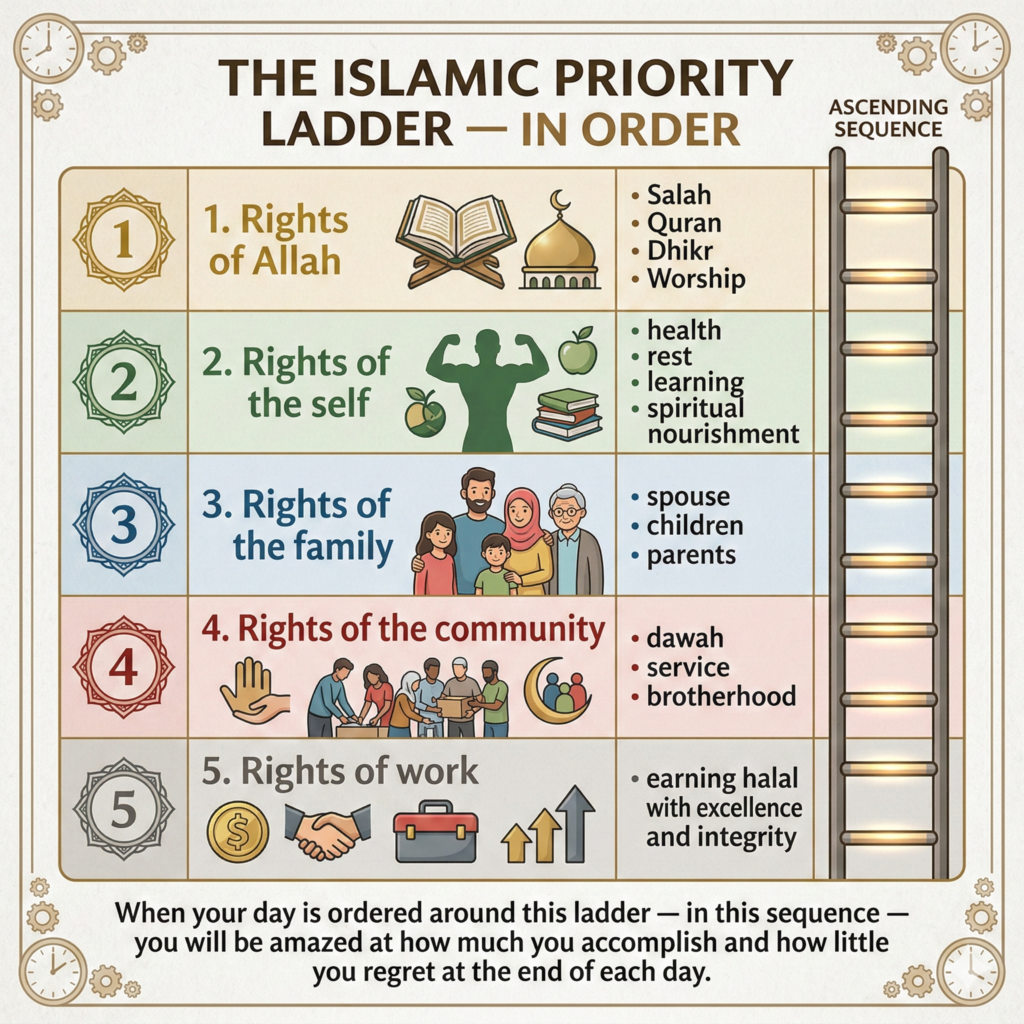
- Rights of Allah — Salah, Quran, Dhikr, worship
- Rights of the self — health, rest, learning, spiritual nourishment
- Rights of the family — spouse, children, parents
- Rights of the community — dawah, service, brotherhood
- Rights of work — earning halal with excellence and integrity
When your day is ordered around this ladder — in this sequence — you will be amazed at how much you accomplish and how little you regret at the end of each day.
5. The Purpose of Properly Using Time
Time management in Islam In our view, there are two fundamental objectives of organizing time in the Islamic framework:
First Objective: Not a Single Moment Should Be Wasted
Allah Almighty has described among the qualities of the true believers in the Quran that they avoid vain and useless matters — Al-Laghw. (Surah Al-Mu’minun: 23:3)
In our time, Al-Laghw looks like hours lost to mindless scrolling, pointless conversations, binge-watching, and empty entertainment that builds nothing and leaves nothing behind. This is not about becoming joyless. Islam honors rest, laughter, and leisure. But it is about consciousness — every hour should carry a purpose, even if that purpose is genuine renewal and rest.
Second Objective: Fulfilling Every Right That Allah Has Placed Upon You
Out of the twenty-four hours we receive daily, we must honestly reflect: How much time do we dedicate to fulfilling our obligations — the rights placed upon us by Allah Almighty?
The rights of Allah through worship. The rights of our family through presence. The rights of our community through service. The rights of our soul through learning. These are not suggestions. They are obligations — and time is the only currency with which they can be paid.
6. Beginning the Day Before Fajr — The Most Powerful Habit
Time management in Islam is one Sunnah that the Prophet (peace be upon him) emphasized repeatedly for both spiritual elevation and worldly barakah — it is the habit of rising early.
The Messenger of Allah (peace be upon him) said in many narrations:
| “If you wake up early in the morning, there will be blessing in your sustenance and wealth; and if you do not wake up early, you will remain worried and distressed.” |
| — Prophet Muhammad (SAW) |
One day, the Prophet (peace be upon him) visited his daughter Hazrat Fatimah (may Allah be pleased with her) in the morning while she was resting. He woke her and said:
| “My daughter, wake up and be present at the time when your Lord distributes sustenance, and do not be among the heedless — for Allah distributes provision between the time of dawn and sunrise.” |
| — Prophet Muhammad (SAW) |
Imam Tirmidhi narrated that the Prophet (peace be upon him) made a specific dua:
| “O Allah, grant blessings to my Ummah in the early hours of the morning.” |
| — Prophet Muhammad (SAW) — Tirmidhi |
It is also narrated:
| “In the last portion of the night, Allah descends to the lowest heaven and calls out: Who will ask Me so that I may give him? Who will seek from Me so that I may fulfill his need?” |
| — Sahih Al-Bukhari |
There is no more precious time in the entire twenty-four hours than this. Organizing time means using one’s prime time in the best possible way. No leadership in the world has achieved great success without the habit of rising early.
If we wake up at five in the morning, the work we do in three hours during the day can be completed in one hour in the morning. We will feel as though the day never ends.
Without adopting this Sunnah and this habit, neither success in the Hereafter nor superiority in this world is truly possible.
What the Pre-Fajr Hours Look Like in Practice
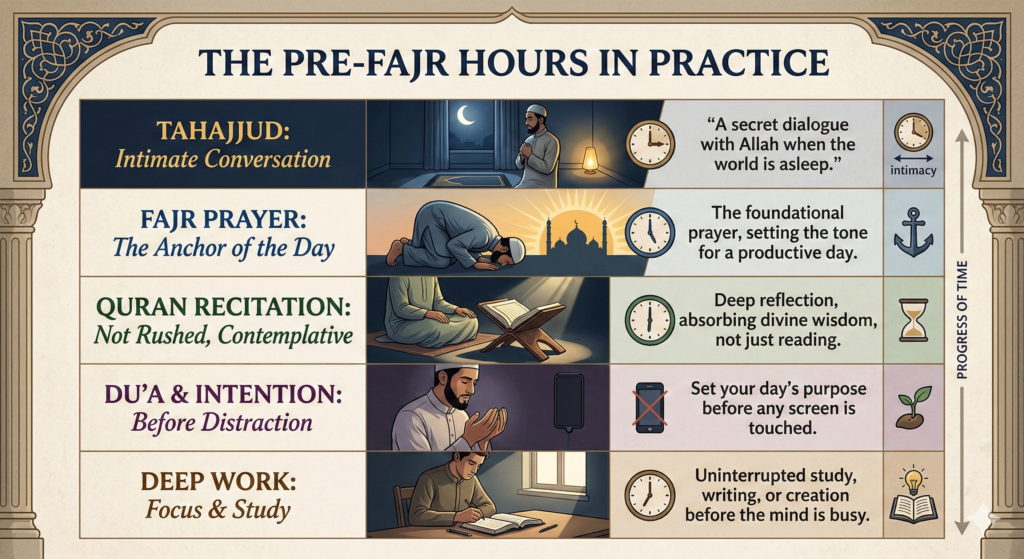
- Tahajjud — the most intimate conversation with Allah, when the world is asleep
- Fajr prayer — the anchor of the entire day
- Quran recitation with reflection — not rushed, but contemplative
- Du’a for the day — setting intention before any screen is touched
- Deep work, writing, or study — before distraction enters the mind
7. Planning Your Economic Life the Islamic Way
Every individual should allocate a specific time for earning a livelihood and determine how much of his time is spent on it. We believe that everyone’s provision is decreed by Allah. Whatever Allah has written in our destiny will reach us — whether we work eight hours or sixteen hours.
The Prophet (peace be upon him) said:
| “Provision pursues a person. Do not be distressed over delay or reduction in sustenance, and earn your livelihood with dignity and good conduct.” |
| — Prophet Muhammad (SAW) — Al-Targhib wa Al-Tarhib |
Researchers say that when a person spends more than eight hours on earning a livelihood, the extra time is generally not productive. That is precisely why in Western societies, employment is typically limited to eight hours — and people are encouraged to complete their share of work within that focused time.
We too should fix a time for our livelihood not exceeding eight hours and work with full strength, energy, and concentration during that period.
Many people have personally experienced that tasks previously done in twelve or fourteen hours can be completed in eight hours when done with full presence and intention — resulting in a significant increase in available time for worship, family, and self-development.
The Barakah Principle for the Muslim Entrepreneur
Islam introduces a concept no business school teaches: Barakah — divine blessing that multiplies the output of your efforts. It is why some people accomplish more in two focused, halal hours than others do in eight distracted ones.
Barakah has conditions. Begin with Bismillah. Keep your earnings halal. Give sadaqah generously. Take the Prophetic rest after Dhuhr — the Qaylulah — which renews afternoon energy. These are not rituals separate from productivity. They are the engine of it.
8. Learn to Say No — The Forgotten Sunnah of Boundaries
In daily dealings, sometimes due to formality or relationships, we make commitments that we are unable to fulfill due to lack of time. As a result, those to whom we made promises face difficulty — and our credibility is damaged.
One should ensure before committing time that it is truly possible to fulfill that commitment. Apologizing before a commitment is wisdom. Failing to honor a commitment after giving one is a breach of trust — and in Islam, fulfilling trusts is not optional.
In the Western world, it is said: if you have learned to say ‘no,’ you have saved half of your time.
In Islam, this goes deeper. Every yes you give is a covenant. Every commitment you make is an amanah. The Prophet (peace be upon him) listed fulfilling trusts among the defining signs of a true believer. To say yes to everything is not generosity — it is a failure to protect the amanah of your time and your word.
Practical Rules for Honoring Time Commitments
- Do not commit to a time unless you have verified it is available and realistic
- If a conflict arises, inform the other party immediately — delay makes it worse
- Prioritize existing commitments over new ones — first come, first honored
- Learn to say: ‘Let me check before I confirm’ — this is not weakness, it is wisdom
- Remember: a broken commitment is a broken trust — and trust, once broken, is the hardest thing to rebuild
8. Learn to Say No — The Forgotten Sunnah of Boundaries
In daily dealings, sometimes due to formality or relationships, we make commitments that we are unable to fulfill due to lack of time. As a result, those to whom we made promises face difficulty — and our credibility is damaged.
One should ensure before committing time that it is truly possible to fulfill that commitment. Apologizing before a commitment is wisdom. Failing to honor a commitment after giving one is a breach of trust — and in Islam, fulfilling trusts is not optional.
In the Western world, it is said: if you have learned to say ‘no,’ you have saved half of your time.
In Islam, this goes deeper. Every yes you give is a covenant. Every commitment you make is an amanah. The Prophet (peace be upon him) listed fulfilling trusts among the defining signs of a true believer. To say yes to everything is not generosity — it is a failure to protect the amanah of your time and your word.
Practical Rules for Honoring Time Commitments
Remember: a broken commitment is a broken trust — and trust, once broken, is the hardest thing to rebuild
Do not commit to a time unless you have verified it is available and realistic
If a conflict arises, inform the other party immediately — delay makes it worse
Prioritize existing commitments over new ones — first come, first honored
Learn to say: ‘Let me check before I confirm’ — this is not weakness, it is wisdom
9. People Also Ask — 5 FAQs on Time Management in Islam
Q: What does Islam say about time management?
A: Islam treats time as one of the greatest trusts (amanah) given to human beings. The Quran and the Noble Prophet (peace be upon him) informed the world about the importance of time and all related matters 1,400 years ago — long before the modern world began organizing seminars and workshops on productivity. We will be asked on the Day of Judgment about how we spent our life, our youth, our wealth, and our knowledge
Q: Why is time so important in Islam?
A. Because we will be held accountable for every moment of it before Allah on the Day of Resurrection. The Prophet (SAW) said a person will not move forward from the field of Resurrection until he has accounted for his entire life — how he spent his age and his youth being the first two questions. Time is the raw material of your Akhirah.
Q: What is the Hadith about time in Islam?
A: One of the most powerful hadiths on time is: ‘Take advantage of five before five: your youth before your old age, your health before your illness, your wealth before your poverty, your free time before you become busy, and your life before your death.’ (Al-Targhib wa Al-Tarhib). Another powerful narration states: ‘Destroyed is the one whose today is not better than his yesterday
Q: What is the best time of day in Islam for worship and productivity?
A: The pre-dawn hours — from the last third of the night through sunrise — are the most blessed time of the entire twenty-four hours. Allah descends to the lowest heaven in the last third of the night and accepts du’a. The Prophet (SAW) made a specific dua for barakah in the early morning hours. There is no more precious time in the entire day than this — and organizing your life means using this prime time in the best possible way
10. Conclusion — Your Time Is Your Legacy
Let us return to the image of the ice seller one final time.
| “The example of time is like that of a seller of ice who keeps calling out: Look! The capital of my life is melting away. If this ice is not put to use, it will melt away on its own and be finished.” |
| — A Wise Elder — as narrated by Imam Razi |
The ice is melting. Right now. As you read these words. The scholars who came before us understood this. They wrote by candlelight after Fajr. They memorized Quran in the hours before dawn. They traveled for months to verify a single hadith. They did not have more hours than you. They had different priorities — and they protected those priorities with their lives
Time management in Islam was never a self-help topic. It is a question of who you will be when you stand before Allah and He asks you: ‘I gave you a life. I gave you youth. I gave you health and free time. Show Me what you built with it.’
The Prophet (peace be upon him) gave us the final word:
| “Every new day, when it begins, calls out: O son of Adam! I am a new creation and a witness to your deeds. So take something from me, for I will never return until the Day of Judgment.” |
| — Prophet Muhammad (SAW) |
Today is a new creation. It is calling out to you right now.
Will you answer?
| Share This Article — Because Time Is Running Out for All of Us Every scholar, student, speaker, businessman, and Muslim you know is fighting the same battle with time. Give them this guidance. Share this article. And may Allah grant barakah in your time, your work, and your legacy. May Allah grant us all barakah in our time. Ameen. |